
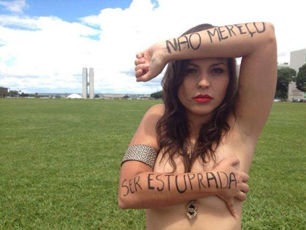
According to a recent survey taken in Brazil, 65% of their citizenship either partially or wholly believe that “if dressed provocatively, women deserve to be attacked and raped.” The study also revealed that 58.5% hold the belief that “if women knew how to behave, there would be less rape.”
The backlash of these findings is a campaign where Brazilian women post pictures of themselves naked, but covering the breasts, with the hashtag #NãoMereçoSerEstuprada, which translates to ‘#IDon’tDeserveToBeRaped.’
This mentality of blaming the victim holds women entirely responsible for being raped, while simultaneously excusing men for raping because he was provoked. That is as absurd as saying that it was my fault I got mugged because I shouldn’t have had money in my wallet that someone could have wanted. Could you imagine a policeman telling another man that if he didn’t want to get his car stolen he shouldn’t have parked it where someone could see and desire it?
Yet how we present ourselves is not the only reason women get raped. Women wearing Burka’s get raped all the time. Were they asking for it by exposing too much eyelid? I also don’t think there is excessive rape in indigenous tribal cultures where women never wear shirts. Men don’t rape women exclusively because they are dressing sexy. Men rape for reasons far more complex and nuanced than a mini skirt.
To truly change the culture of rape we have to examine the causes. As much as we can look at misogyny and sexism in culture, and point out how conditioning and the media enflame the problem, that cannot be the only cause. All men are exposed to the objectification of women, yet not all men are rapist. We need to examine this pattern of men abusing women and recognize that this isn’t just a woman’s problem.
Subjugation is a feedback loop, and both the perpetrator and victim are going to suffer from an act of sexual violence. Yet what varies is how they internalize the experience. It is hard to be sympathetic to the men who exploit women, yet we have to acknowledge that their actions are coming from a place of pain in order to change the behavior. We can’t just be horrified when rape happens and avoid addressing the root cause of what rape means to men.
Rape is asserting your control over someone weaker than you. Rape is having no empathy for the human you are using. Rape is over powering a human. Rape is about dominance.
We live in a culture of dominance, and men in particular feel the pressure to dominate others. The alpha male complex is just as relevant as when we lived a more primal existence, but in modern times dominance permeates past the physical realm and deep into the psychological. Men dominate each other. Bosses often dominate employees, politicians too frequently attempt domination over vulnerable members of our society – this culture of dominance saturates the very systems in which we exist.
The desire to conquer another human is played out in a variety of different means that are not only socially acceptable, but expected. You have to work your way up through a company while tolerating the many men who dominate you in order to one day have the privilege to dominate. The reward for your subservience is to make others your subservient.
The concept of power of domination is embedded into not only the male psychology but also the archetype of the successful man. He is someone who is ruthless, and prioritizes his own needs above everything else to get what he wants. This is the man who society encourages for he is the one who rewarded with riches. And it is this thinking that has permeated the definition of manliness and what is means to be powerful. So it is not impossible to imagine how this influence bleeds into a man’s sexuality.
There is an adrenalin rush in having power over someone else, and asserting your strength. Part of that may have some biological underpinnings, and part of that is socialized. In environments where dominance is unquestioningly integrated into the community, like with competitive sports and the military, you will often find disproportionate accounts of rape.
We cannot put all the pressure on women to avoid getting raped because that is impossible. Rape doesn’t stop with women, it stops with men. Women can’t be the only ones talking about rape. We need to invite men into this conversation and work together to heal those parts of masculinity that drives men to commit violence against women.


